Financial Costs and Return on Investment Guide: Smart Decisions
Every financial decision you make, whether it's buying a home, launching a new product, or simply choosing a savings account, involves an interplay between Financial Costs & Return on Investment (ROI). Understanding this dynamic isn't just for Wall Street professionals; it's a fundamental skill for anyone looking to build wealth, optimize spending, and make genuinely smart choices with their money. This guide cuts through the jargon to give you the clarity and tools you need to assess opportunities and achieve your financial goals.
At a Glance: Your Quick Takeaways
- ROI is "Benefit divided by Cost": It's a simple, powerful ratio to see how much you gain relative to what you put in.
- Not All ROIs Are Equal: A "good" ROI depends heavily on your goals, risk tolerance, and the type of asset.
- Time Matters: Basic ROI can be misleading; Annualized ROI offers a more accurate comparison over different periods.
- Don't Forget All Costs: A true ROI calculation must include every expense, visible and hidden.
- Leverage is a Double-Edged Sword: It can amplify returns but also magnify losses. Use with caution and strategic planning.
- Beyond Basic ROI: More sophisticated metrics like IRR, ROE, and ROA provide deeper insights for specific scenarios.
Unpacking the Core: What Exactly is Return on Investment (ROI)?
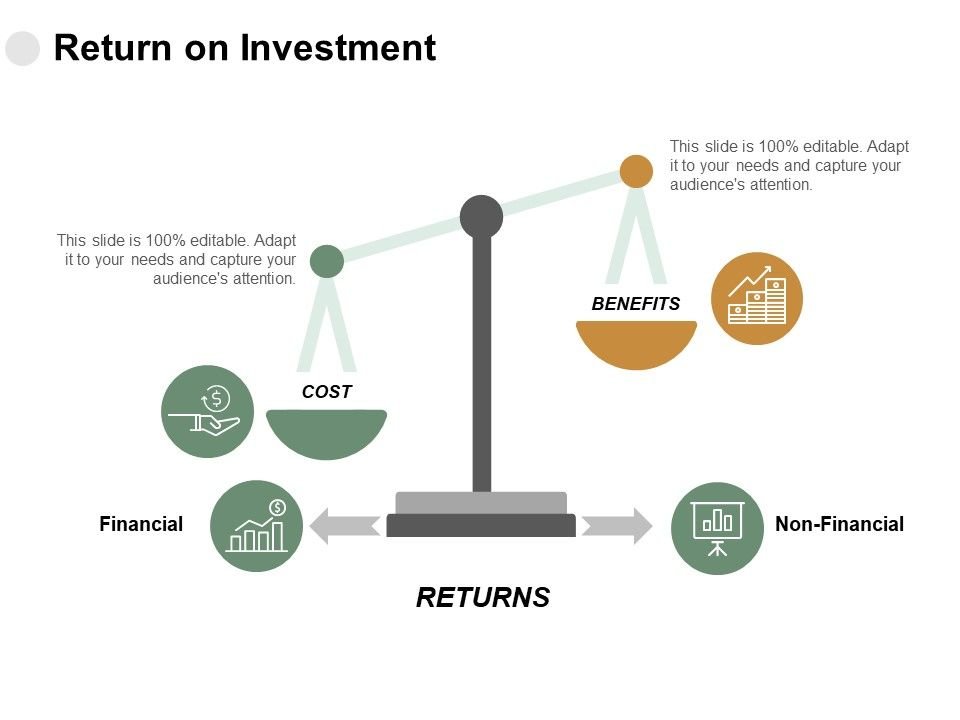
At its heart, Return on Investment (ROI) is a performance measure that tells you how much benefit you've received compared to the cost of that benefit. Think of it as your financial scorecard: did you get more out than you put in? And if so, how much more?
In the simplest terms, ROI answers the question: "Was this investment worth it?" It's a critical tool for comparing different options, assessing past outcomes, and intelligently allocating your hard-earned capital.
The Simple Formulas That Drive Smart Decisions
While there are nuances, most ROI calculations boil down to two core formulas:
- ROI = Net Income / Cost of Investment (This is the most widely used and intuitive version.)
- ROI = Investment Gain / Investment Base
Conceptually, you can always remember it as "benefit" divided by "cost."
Let's look at a straightforward example:
Imagine an investor purchases a rental property for $500,000. Two years later, they sell it for $1,000,000.
The "Investment Gain" or "Net Income" here is the selling price minus the purchase price: $1,000,000 - $500,000 = $500,000.
Using the first formula:
ROI = $500,000 (Net Income) / $500,000 (Cost of Investment) = 1, or 100%.
This tells us that for every dollar invested, the investor gained another dollar back. A 100% return is certainly a strong performance!
Defining "Good": Why a Universal ROI Doesn't Exist
When someone asks, "What's a good ROI?" the only honest answer is: "It depends." The ideal return on investment isn't a fixed number; it's a moving target influenced by several crucial factors unique to each situation and investor.
Here's what shapes what a "good" ROI looks like for you:
- Your Risk Tolerance: Generally, higher potential ROI comes with greater volatility and risk. Are you comfortable with significant fluctuations for the chance of bigger gains, or do you prefer more modest, stable returns? What one investor considers acceptable risk, another might deem reckless.
- The Holding Period: A 20% return over six months is vastly different from a 20% return over ten years. A high return achieved in a shorter timeframe is usually more valuable because your capital is tied up for less time. We'll dive deeper into this with Annualized ROI shortly.
- Expected ROI and Benchmarks: It's vital to compare your projected results against relevant industry data or historical averages for similar asset types. A 5% ROI on a high-yield savings account is excellent, but a 5% ROI on a startup venture might be considered very poor. Looking at tips untuk menganalisis rasio keuangan perusahaan can help you benchmark against specific company or industry standards.
- Opportunity Costs: Every dollar you invest in one opportunity is a dollar you can't invest elsewhere. A "good" ROI should ideally outperform what you could have earned by putting your money into the next best alternative.
- Asset Type: Expectations vary wildly across different investment categories.
- Rental Properties: Often yield consistent income alongside potential appreciation.
- Startups: High risk, high reward – typically looking for multi-bagger returns.
- Blue-Chip Stocks: Generally offer more moderate, stable growth with dividends.
- Long-term index funds might realistically target 7-10% annually over decades, while a speculative crypto asset might promise 1000% with immense volatility.
Ultimately, you define ROI success based on your personal financial goals, your comfort with risk, and the trade-offs you're willing to make. Context and consistency in your investment approach are far more important than chasing arbitrary high numbers.
The Power and Pitfalls of the Basic ROI Formula
The simplicity of the ROI formula is both its greatest strength and its most significant weakness.
The Undeniable Benefits of Using ROI
- Guides Investment Decisions: ROI helps you objectively compare potential investment opportunities. Faced with multiple options, you can quickly calculate their projected returns and choose the one that aligns best with your goals.
- Assesses Past Performance: It provides a clear indicator of how an investment has performed, telling you whether it generated a positive (or negative) return.
- Optimizes Portfolios: By reviewing the ROI of existing assets, you can identify low-performing investments to potentially reallocate capital towards more profitable ventures.
- Ease of Calculation: With just two core figures (benefit and cost), it's straightforward to compute, making it accessible even for novice investors.
- Universally Understood: ROI is a common language in finance, making it easy to communicate and compare performance across different industries and stakeholders.
The Critical Limitations: Why Simple ROI Isn't Always Enough
While powerful, the basic ROI formula has blind spots that can lead to skewed conclusions if not understood.
- It Disregards the Factor of Time: This is perhaps the biggest limitation. A 50% ROI over three years is presented identically to a 50% ROI over five years. Yet, the three-year investment is clearly superior as it frees up your capital sooner. Without considering time, you might mistakenly choose a slower-performing asset. To effectively compare, investments must be evaluated over the same time period and under similar market circumstances.
- Susceptible to Manipulation and Omission: The "cost" in ROI can be selectively defined. If you're calculating ROI on a rental property, for example, neglecting ongoing maintenance, property taxes, insurance, management fees, or renovation costs will artificially inflate your perceived return. A truly accurate ROI calculation must account for all possible incurred costs – direct, indirect, upfront, and ongoing. This comprehensive view ensures you're not getting a pleasant surprise today that turns into a costly regret tomorrow.
Bringing Time into the Equation: The Annualized ROI Formula
To overcome the basic ROI's time limitation, financial experts use the Annualized ROI Formula. This powerful calculation normalizes returns over different timeframes, allowing for accurate, apples-to-apples comparisons.
The formula looks like this:
Annualized ROI = [(Ending Value / Beginning Value) ^ (1 / # of Years)] – 1
Where:
# of Years = (Ending Date – Starting Date) / 365 (This converts the exact number of days into a fractional year.)
Let's revisit our earlier example to see the difference.
Suppose a stock was bought on January 1, 2017, for $12.50 and sold on August 24, 2017, for $15.20.
First, calculate the Regular ROI:
Net Income = $15.20 - $12.50 = $2.70
Regular ROI = $2.70 / $12.50 = 0.216 or 21.6%
Now, let's annualize it:
Number of days = (Aug 24, 2017 - Jan 1, 2017) = 235 days
of Years = 235 / 365 ≈ 0.6438 years
Annualized ROI = [($15.20 / $12.50) ^ (1 / 0.6438)] – 1
Annualized ROI = [(1.216) ^ (1.5532)] – 1
Annualized ROI ≈ 1.355 – 1 ≈ 0.355 or 35.5%
The Annualized ROI of 35.5% paints a much clearer picture of the investment's annualized performance, highlighting that the 21.6% return was achieved in less than a full year, suggesting a much stronger underlying growth rate. This is critical when comparing two investments held for different durations.
Amplifying Returns (and Risks): The Role of Leverage
Leverage is a strategy where you use borrowed capital to increase the potential return of an investment. In essence, it allows you to control a larger asset with less of your own personal cash. While it can dramatically boost your ROI, it also comes with significant risks.
How Leverage Impacts ROI
When an investment performs well, leverage amplifies your gains because your return is calculated on the total asset value, even though you only contributed a portion of the capital.
Example:
You identify an asset worth $200,000 that you believe will generate a $20,000 profit.
- Scenario 1: No Leverage (100% Cash)
- Your investment: $200,000
- Profit: $20,000
- ROI = $20,000 / $200,000 = 0.10 or 10%
- Scenario 2: With Leverage (80% Financing)
- You borrow $160,000 (80% of $200,000).
- Your personal investment (equity): $40,000
- Profit: $20,000
- ROI = $20,000 / $40,000 = 0.50 or 50%
In this example, leverage turned a 10% ROI into a 50% ROI on your invested capital. This amplification is why leverage is so attractive in certain investment circles.
The Benefits of Strategic Leverage
- Greater ROI Potential: As seen above, leverage can significantly increase returns on your equity.
- Access to Higher-Value Investments: It allows individuals or companies to invest in assets they otherwise couldn't afford outright.
- Improved Capital Efficiency: You can potentially achieve the same returns with less of your own capital, freeing up funds for other opportunities.
The Risks: When Leverage Backfires
- Losses Multiply Quickly: Just as leverage amplifies gains, it also magnifies losses. If the $200,000 asset in our example lost $20,000, your personal $40,000 investment would be halved (a 50% loss) in the leveraged scenario, compared to only a 10% loss without leverage.
- Reduced Net Return Due to Interest and Fees: Borrowing money isn't free. Interest payments and financing fees eat into your profits, potentially negating some of the amplified gains.
- Greater Sensitivity to Market Shifts: Leveraged positions are more vulnerable to adverse market movements, as even small dips can trigger significant losses on your equity.
- Margin Calls: In some leveraged investments, if the value of the asset drops significantly, the lender may demand additional capital (a "margin call") to maintain the loan-to-value ratio. Failure to provide this can lead to forced liquidation of your asset at a loss.
Understanding membedakan utang produktif dari utang konsumtif is crucial here. Leverage is generally considered productive debt if used strategically for assets with high growth potential, but it quickly becomes a liability if the investment underperforms or if the interest costs are too high.
Strategic Use of Leverage
If you're considering leverage, proceed with extreme caution and thorough planning:
- Model Worst-Case Scenarios: Always calculate what happens if the investment performs poorly. Can you withstand the potential losses?
- Match Leverage to Your Risk Profile: Don't take on more debt than you're comfortable with losing.
- Use Planning Tools: Financial modeling and stress testing can help you understand the full spectrum of potential outcomes.
Beyond Simple ROI: Advanced Metrics for Deeper Insight
While ROI is a fantastic starting point, more sophisticated financial scenarios demand more nuanced metrics. These alternatives address specific limitations or offer a different lens through which to view an investment's value.
1. Internal Rate of Return (IRR)
The Internal Rate of Return (IRR) is a far more sophisticated measure, especially for projects or investments with multiple cash flows over their lifetime (e.g., a business venture with ongoing expenses and revenues, or a property generating rental income and then sold).
- What it Measures: IRR calculates the annual percentage growth rate that an investment is expected to generate. Critically, it accounts for the timing of all cash flows – inflows and outflows – over an investment's life.
- Why it's Preferred: IRR is superior to basic ROI for multi-period investments because it intrinsically incorporates the time value of money, meaning a dollar today is worth more than a dollar tomorrow. This makes it a preferred metric in industries like private equity, real estate development, and venture capital.
- How it Works (Conceptually): It's the discount rate that makes the Net Present Value (NPV) of all cash flows from a particular project equal to zero. Essentially, it finds the rate at which the investment "breaks even" when factoring in the time value of money.
2. Return on Equity (ROE) & Return on Assets (ROA)
ROE and ROA are specific types of return metrics often used in corporate finance to assess a company's profitability and efficiency. While they are annual rates of return, they differ from general ROI by having precisely defined denominators.
- Return on Equity (ROE):
- Formula: Net Income / Shareholder Equity
- What it Measures: How much profit a company generates for each dollar of shareholder equity. It reflects how efficiently a company is using shareholder investments to generate profits.
- Use Case: Investors use ROE to gauge a company's profitability and management effectiveness from the perspective of equity investors. A high ROE usually indicates a company is good at turning shareholder money into profit.
- Return on Assets (ROA):
- Formula: Net Income / Total Assets
- What it Measures: How efficiently a company is using all its assets (both debt and equity financed) to generate profit.
- Use Case: ROA provides an overall picture of how profitable a company is relative to its total assets. It's a useful indicator for comparing companies within the same industry, as different sectors can have vastly different asset bases.
Both ROE and ROA offer more specific definitions for their denominators than the generic "cost of investment" or "investment base" used in a broad ROI calculation. However, like basic ROI, they do not inherently consider the timing of cash flows, which is where IRR shines.
Your Guide to Calculating ROI in Real Life
Applying ROI isn't just an academic exercise; it's a practical skill. Here's how to approach it effectively:
Step-by-Step Process for Accurate ROI Calculation
- Clearly Define the Investment Scope: What exactly are you analyzing? Is it a single stock purchase, a complete business acquisition, a marketing campaign, or a personal development course?
- Identify ALL Financial Costs: This is where many go wrong. Think beyond the sticker price.
- Direct Costs: Purchase price, setup fees, initial capital outlay.
- Indirect/Hidden Costs: Maintenance, taxes, insurance, interest on borrowed capital, professional fees (e.g., legal, accounting), marketing expenses, training costs, opportunity costs of your time. If you're considering manfaat memiliki dana darurat yang cukup, think about how this investment might free up cash for other ventures that could incur their own costs.
- Time Value of Money: For longer-term projects, consider inflation or the cost of capital.
- Quantify ALL Benefits (Net Income/Gain):
- Direct Revenue: Sales, rental income, dividends, capital appreciation (selling price - purchase price).
- Indirect Benefits (if quantifiable): Cost savings (e.g., new machinery reducing labor costs), increased efficiency, tax benefits.
- Choose the Right Formula:
- Basic ROI: For quick, single-period assessments where time isn't a significant differentiator.
- Annualized ROI: When comparing investments held for different durations.
- IRR: For complex projects with multiple cash inflows and outflows over time.
- Calculate and Interpret: Run the numbers. Don't just look at the percentage; understand what it means in the context of your goals, risk tolerance, and the asset type.
Practical Examples & Mini Case Studies
- Real Estate Investment:
- Cost: Purchase price ($300,000) + closing costs ($10,000) + renovation ($20,000) + property taxes/insurance/maintenance over 3 years ($15,000) = $345,000
- Benefit: Rental income over 3 years ($45,000) + Sale price ($380,000) = $425,000
- Net Income: $425,000 - $345,000 = $80,000
- ROI (Basic): $80,000 / $345,000 = ~23.2%
- ROI (Annualized over 3 years): [(425,000 / 345,000)^(1/3)] - 1 = ~7.19% annual return
- Marketing Campaign:
- Cost: Ad spend ($5,000) + content creation ($1,000) = $6,000
- Benefit: Revenue directly attributed to campaign ($15,000)
- Net Income: $15,000 - $6,000 = $9,000
- ROI: $9,000 / $6,000 = 1.5 or 150% (a great return for marketing!)
- Educational Investment (e.g., a certification):
- Cost: Course fees ($3,000) + lost income during study time ($1,500) = $4,500
- Benefit: Expected increase in annual salary (e.g., $5,000 per year)
- Here, you'd calculate ROI over time. For the first year of increased salary: $5,000 (benefit) / $4,500 (cost) = ~111% ROI. This would continue to generate returns in subsequent years, highlighting the long-term value of such an investment.
Common Pitfalls to Avoid
- Overlooking "Hidden" Costs: Always factor in taxes, fees, maintenance, and the time value of money.
- Focusing Only on Short-Term Gains: Many valuable investments (education, retirement savings) have longer horizons. Use Annualized ROI for comparison.
- Comparing Apples to Oranges: Ensure you're using the same formula and considering similar risk profiles and holding periods when evaluating different options.
- Ignoring Risk: A high potential ROI means little if the risk of total capital loss is equally high and beyond your tolerance.
- Failing to Define Your Goals: An investment's ROI only makes sense in the context of what you want to achieve.
Frequently Asked Questions (and Straight Answers)
What's a realistic ROI?
Realistic ROI varies immensely. Long-term, diversified investments like index funds often target 7-10% annually (after inflation). Higher-risk assets like startups or real estate development may promise much more but come with greater volatility and potential for loss. For short-term ventures, a 20-30% ROI might be excellent, while for extremely safe, liquid assets, 1-3% might be expected. The key is to compare against relevant benchmarks for the specific asset type, holding period, and risk profile.
How do I calculate ROI in Excel?
The basic ROI formula in Excel is straightforward:
If your initial investment is in cell A1 and your final value (or net gain) is in cell B1:=(B1 - A1) / A1 for the gain relative to initial investment.
If B1 is the net income (gain - cost), then =(B1 / A1).
To display as a percentage, format the cell as a percentage. For example: =(Final_Value - Initial_Investment) / Initial_Investment * 100%.
What does an ROI percentage mean?
An ROI percentage indicates the proportion of gain relative to the investment as a percentage.
- 100% ROI means you doubled your initial investment (gained 100% of your cost back as profit).
- 50% ROI means you gained half of your initial investment back as profit.
- -10% ROI means you lost 10% of your initial investment.
It's a clear, standardized way to express the efficiency of an investment.
Why is ROI important in business?
In business, ROI is essential for:
- Goal Setting: Helps set realistic performance targets for projects, departments, or the entire organization.
- Performance Measurement: Tracks the success of initiatives like marketing campaigns, product launches, or capital expenditures.
- Strategic Decision-Making: Informs resource allocation, project prioritization, and expansion plans by identifying which ventures offer the most bang for the buck.
- Accountability: Provides a clear metric for evaluating management and team performance.
What's the best way to calculate ROI for maximum accuracy?
The "best" way depends on the context:
- For a quick snapshot or comparing similar, short-term investments: Use the basic ROI formula.
- For comparing investments held for different durations: Always use Annualized ROI.
- For complex projects with multiple, varying cash flows over time: Internal Rate of Return (IRR) provides the most comprehensive picture.
- Crucially, for any calculation: Always factor in every possible incurred cost, direct and indirect, upfront and ongoing, to ensure the most accurate return.
The Bottom Line: Making ROI Work for YOU
Understanding Financial Costs & Return on Investment isn't about memorizing formulas; it's about adopting a mindset that empowers you to make smarter financial decisions. Whether you're a seasoned investor, a small business owner, or simply managing your household budget, applying the principles of ROI can dramatically improve your outcomes.
Stop viewing costs as just expenses; start seeing them as investments that should, ideally, generate a positive return. Be diligent in identifying all costs, be realistic about potential benefits, and always factor in the crucial element of time. By doing so, you'll move beyond guesswork and towards a truly strategic approach to your financial future. Your money works hard for you; ensure it's doing its best work.